September 2, 2026
The Transaction Is the Last Step, Not the First
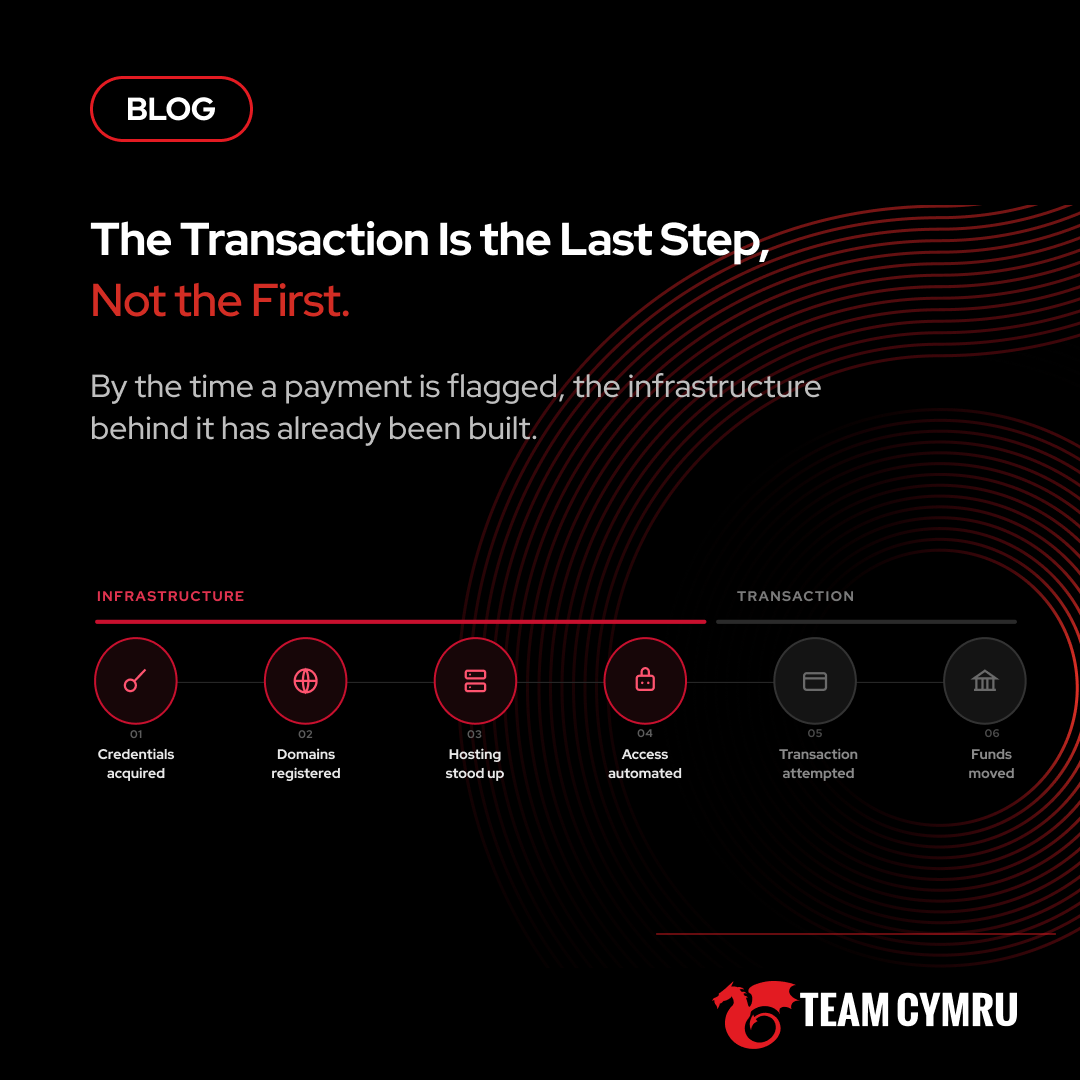
Most fraud programs are built to catch fraud where it becomes visible: at the transaction. That's also the most expensive place to catch it. By the time a payment is flagged, the infrastructure behind it has already been built, the targeting has already happened, and the account has likely already been compromised.
That gap, between where fraud is detected and where it actually originates, is the problem Team Cymru's Fraud Defense Intelligence work is built to close.
Six stages happen before a loss is booked
Fraud doesn't start at checkout. It moves through a kill chain: infrastructure is stood up, targets are identified, engagement occurs, accounts are compromised, and only then does monetization occur. Most fraud programs are built to engage at the last two stages of that chain, the transaction and the monetization that follows it. Five stages run before a loss is booked. Most programs only engage at the last two.
That leaves a wide window where infrastructure intelligence, not transaction data, is what actually helps. NetFlow data, passive DNS, BGP routing intelligence, IP and domain analysis, certificate data, and malware intelligence can surface the infrastructure behind a fraud operation well before it reaches a payment processor. Investigators can move from an isolated indicator, a suspicious IP or domain, to the relationships, infrastructure, and historical activity surrounding it, exposing the broader operation rather than just the transaction in front of them.
Why this matters right now
Fraud is not a static target. Adversary infrastructure gets reused, adversary tactics get shared, and the operators behind one fraud campaign are frequently behind several others running in parallel. Static, transaction-level detection sees each of these as an isolated event. Infrastructure-level visibility sees them as one operation.
That's the layer where Team Cymru works: providing the infrastructure intelligence that lets fraud teams and threat hunters trace an operation backward, from the payment to the compromise, to the infrastructure that made it possible, and forward again into detections, mitigations, and disruption. Our Pure Signal Command platform brings that discovery, understanding, and action into a single investigative workflow, with APIs and MCP integration built for teams that need to move fast and act on what they find.
This is also why we've been an active supporter of the industry's move toward shared, structured fraud intelligence. Standardized frameworks that describe fraud adversary behavior across its full lifecycle, not just at the point of transaction, make this kind of infrastructure-first investigation faster and more consistent across organizations. It's why we've supported the development of FT3, the fraud taxonomy created by Vincent Passaro at Stripe, with engineering resources and infrastructure intelligence as it evolves into FT3 2.0. And it's the same reason we continue to invest engineering resources and threat research directly into the practitioner communities where fraud intelligence gets built and tested.
"Some of the most important advances in security don't begin inside a company or a product roadmap; they begin with practitioners solving real problems together," said Joe Sander, CEO of Team Cymru.
"Our role is to support that work: providing engineering resources, intelligence and infrastructure visibility where we can be useful, and helping sustain the trusted communities where practitioners share what they know," said Mike Barry, VP of Engineering at Team Cymru. "The goal is not ownership. It is making it easier for good people doing difficult work to learn from one another and build something stronger together."
Visibility before the transaction
Fraud will always eventually show up in a payment. But by the time it does, the more valuable window for stopping it has usually already closed. Getting visibility into the infrastructure, targeting, and compromise stages that precede the transaction doesn't just catch more fraud; it catches it earlier, when there's still time to act.
That's the premise behind Fraud Defense Intelligence at Team Cymru, and it's the lens we bring to every fraud investigation we support.
Learn more about Fraud Defense Intelligence at team-cymru.com/fraud-defense-intelligence.