Reduce fraud investigation time
Move from an isolated indicator to the relationships, infrastructure, and historical activity surrounding it.
Fraud Defense Use Case
Fraud does not begin with a transaction. It develops across the internet services, applications, infrastructure, and adversary ecosystems that make fraudulent activity possible.
Team Cymru gives fraud intelligence teams the visibility and context needed to uncover those connections, accelerate investigations, and move from isolated indicators to informed action.
Built for
Visibility from
Delivered in
See Beyond the Transaction
Transaction data shows what happened. Fraud intelligence helps reveal how it happened.
Most fraud detection and prevention programs are strongest at the point of transaction. But by the time suspicious activity reaches a payment system, an adversary may already have:
"Fraud is monetized in payments. It is built everywhere else."
Effective fraud defense requires visibility before, around, and beyond the transaction, not only at the final point of monetization.
The kill chain of fraud
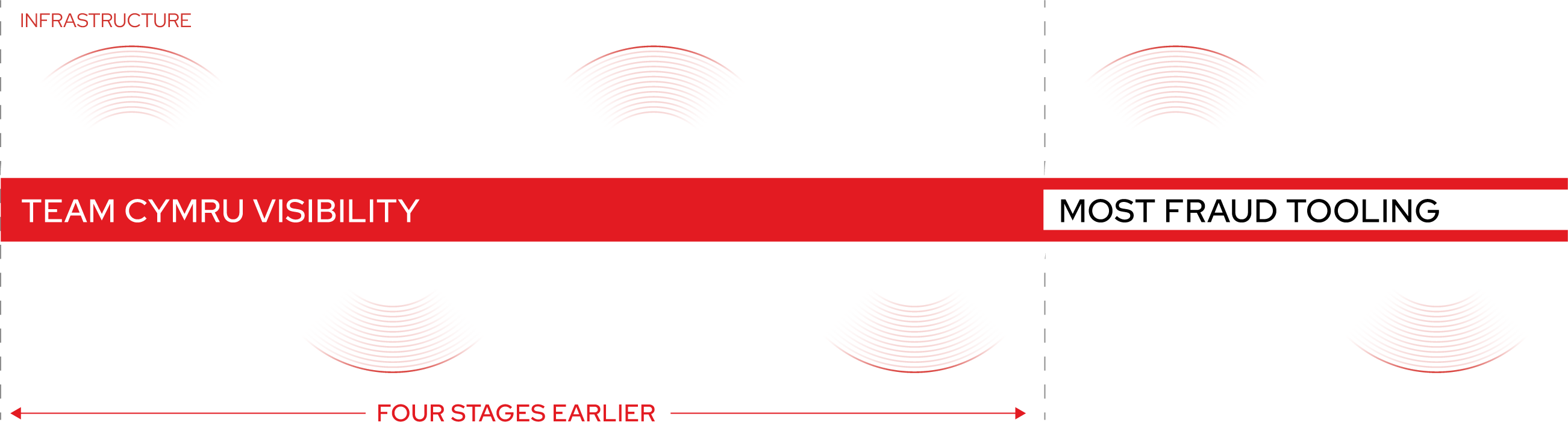
Six stages run before a loss is booked. Most programs only engage at the last two.
Team Cymru visibility · stages 01 to 04
01 · Build
Infrastructure
Domains, hosting, IPs, services, and fake sites are assembled to support the operation.
02 · Target
Targeting
That infrastructure is directed toward institutions, accounts, employees, or customer populations.
03 · Engage
Lure and engagement
Phishing, impersonation, malicious domains, and redirects bring the victim into the operation.
04 · Compromise
Access and control
Credentials, sessions, accounts, devices, or victim behavior are compromised to establish control.
05 · Transact
Fraud execution
The operation reaches the payment, account, or claims system and fraudulent activity is initiated.
06 · Cash out
Monetization
Funds move out through mule accounts, purchases, transfers, withdrawals, or crypto channels.
Where fraud detection often begins
What earlier visibility changesStages 01 through 04 are where infrastructure is built, directed, and reused. Seeing them turns a single indicator into the shape of an operation, while there is still something to disrupt.
What waiting costsBy the time fraud reaches the transaction layer, the adversary may already have built the infrastructure, reached the victim, and established control. The remaining decision is increasingly about stopping the loss rather than disrupting the operation.
Intelligence Sources
Team Cymru helps fraud defenders investigate the external relationships and activity behind fraudulent campaigns using:
NetFlow visibility
Passive DNS
IP and domain intelligence
BGP and routing context
Web certificates
Service and infrastructure fingerprints
Malware intelligence
Historical and current relationships
Graph-based investigation
AI-assisted analysis and automation
The value is not simply access to more data. Team Cymru helps investigators move faster from a suspicious artifact to a clearer understanding of the broader operation surrounding it.
From a single domain, IP address, certificate, service, or other observable, fraud intelligence teams can uncover connected activity, historical relationships, and additional indicators that may support the same campaign or operator.
Operational Outcomes
Earlier visibility changes what a fraud team can do with an indicator: how fast it resolves, how much of the operation it exposes, and whether the response ends at containment or reaches disruption.
Move from an isolated indicator to the relationships, infrastructure, and historical activity surrounding it.
Find domains, IP addresses, certificates, services, and other resources that may belong to the same campaign, operator, or adversary ecosystem.
Turn adversary behavior and external intelligence into more informed detection logic, analytics, investigative processes, and defensive workflows.
Distinguish isolated suspicious activity from indicators connected to broader malicious operations.
Develop stronger evidence packages for takedowns, platform coordination, law enforcement engagement, and partner collaboration.
Make fraud intelligence accessible to analysts, investigation tools, internal systems, AI assistants, and agents.
Fraud Intelligence Use Cases
Each of these starts with something a fraud team already has: an address, a domain, a certificate, a case that does not add up.
Start with an IP address, domain, certificate, service, or other observable and uncover the surrounding relationships and activity.
Identify reused resources, common services, historical relationships, and patterns that connect seemingly separate fraud events.
Investigate the infrastructure and services supporting credential theft, credential testing, automated access, and account exploitation.
Trace domains, hosting, certificates, IP relationships, and adjacent resources associated with phishing, impersonation, and other fraudulent activity.
Develop greater context around the resources enabling automated account creation, credential attacks, scraping, testing, and transaction abuse.
Bring external fraud intelligence into internal analytics, cases, detection systems, investigative workflows, and agentic environments.
Give analysts, partners, trust groups, platforms, and law enforcement the context needed to understand connected activity and take informed action.
FT3 2.0
They need a shared way to describe adversary behavior, connect fraud intelligence to defensive action, and carry that knowledge into investigations, detections, mitigations, and automation.
200+
Techniques in FT3 2.0, alongside analytics, detections, mitigations, and agentic profiles
Team Cymru is proud to be a long-standing supporter of FT3 and the practitioner communities helping it evolve. We believe fraud defense improves when defenders have a shared language, meaningful intelligence, and the ability to carry both directly into action.
Built for the community
The tools defenders need, at no cost
Built With the People Doing the Work
An open repository may demonstrate interest. Effective fraud defense depends on something deeper: reciprocity, trusted relationships, meaningful contributions, and a shared commitment to action.
Fraud crosses organizational, geographic, and industry boundaries. The communities defending against it must be able to do the same.
Team Cymru supports trusted, practitioner-led environments where analysts, researchers, hunters, builders, and investigators can share intelligence, teach one another, and solve problems together.
The strongest fraud defense does not come from one company, one sector, one fraud investigation tool, or one dataset. It comes from trusted people combining visibility, intelligence, expertise, and action.
Pure Signal Command
Pure Signal Command brings Team Cymru visibility and intelligence into one operational environment, helping fraud investigators discover, understand, investigate, and act.
Step 01
Discover
Step 02
Understand
Step 03
Act
Command supports the investigative workflow without replacing existing fraud detection and prevention systems. It gives defenders the external visibility and intelligence needed to understand what may exist beyond the transaction.
The mission
The mission is what matters.
Team Cymru is honored to advance that mission by supporting better fraud intelligence, faster investigations, stronger collaboration, and better outcomes for the people fighting fraud every day.
Team Cymru

Act before losses compound
Visibility before the transaction
is time you get back.
Fraud evolves through connected services, infrastructure, behaviors, adversaries, and communities. Defending against it requires visibility beyond the transaction, fraud intelligence that reveals the broader operation, and investigative tools that can move at the speed of the adversary.