Real-time threat
intelligence on any IOC.
IOC threat hunting where infrastructure context arrives attached, before an analyst has to go looking for it.
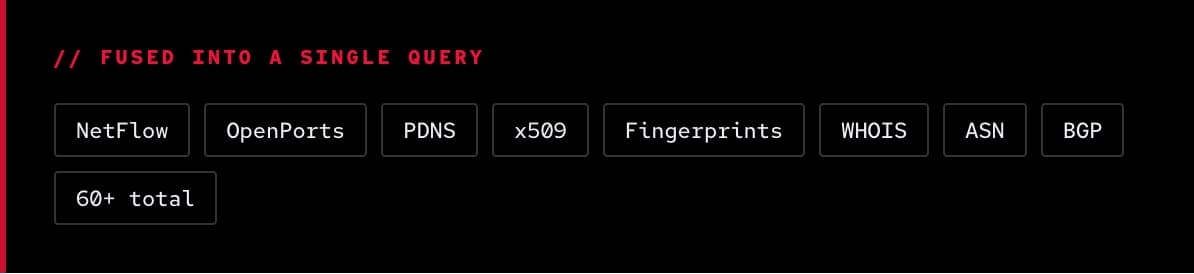
Scout resolves an indicator into the story behind it. NetFlow, passive DNS, x509, open ports, WHOIS, and fingerprints fuse into one enriched, tagged return, so triage stops being reconstruction and becomes a decision an analyst can defend.
An indicator arrives. The context does not.
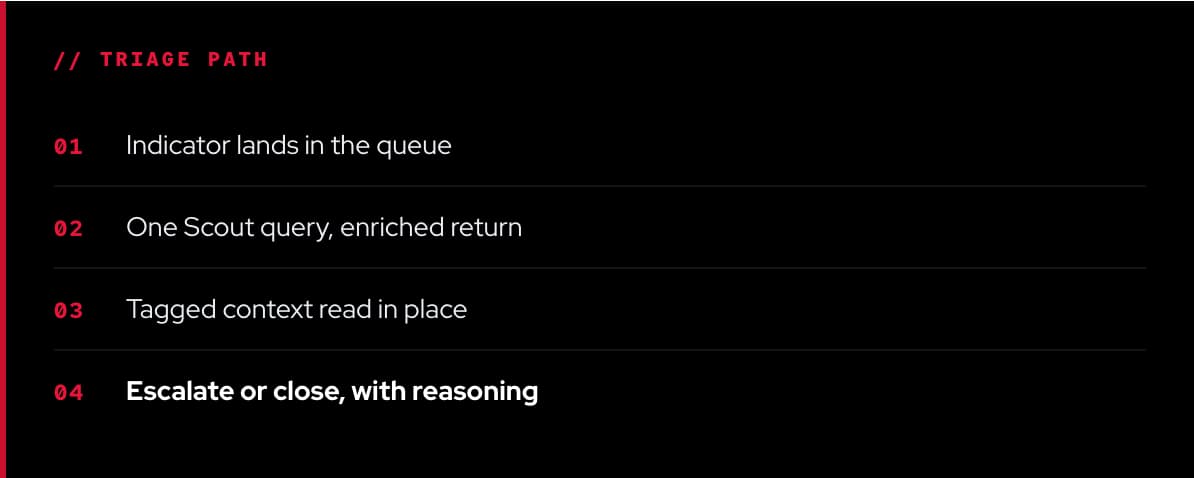
An IP or a domain lands in the queue carrying almost nothing: no ASN, no routing behavior, no certificate history, no sense of what else it touches. Analysts rebuild that story by hand, every time, across four or five tools. Scout returns the story with the indicator, so the first look is already the informed one.
unmatched speed
One tool, no training period
Every analyst gets immediate visibility into malicious and suspicious indicators through a single interface that does not require weeks of onboarding to be useful on day one.
Response Speed
One search, comprehensive answer
A single query returns enriched, tagged results with intuitive visualizations, so incident response moves from gathering evidence to acting on it inside the same window.
Consolidatiion
Fewer tools, fewer seams
Multiple data types and sources fuse into one return without scripting, and native integrations with leading TIP, SOAR, and SIEM tooling keep the work inside existing workflows.
Context dies in the seams between tools. Junior analysts spend their shift rebuilding what senior analysts already learned.
Four things a single query gives back.
Speed matters only if the answer is complete. Each capability below removes a reason an analyst would otherwise open another tab.
SOC ENABLEMENT
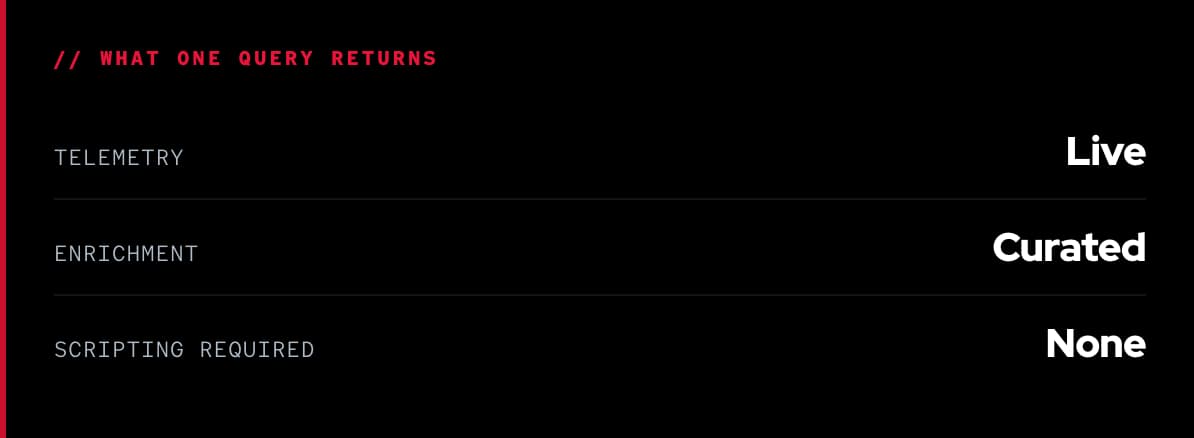
Access live telemetry to uncover malicious and suspicious infrastructure as it operates. Pivot continuously to identify and assess threats across the internet rather than waiting for a collection window to close.
UNIQUE INSIGHTS AT SCALE
Summarized and detailed insight across NetFlow, open ports, passive DNS, x509 certificates, fingerprints, and WHOIS, drawn from the Pure Signal data foundation rather than assembled from separate subscriptions.
Instant Results
One query lets analysts search a vast intelligence set and receive an immediate response, matching speed with completeness so an escalation decision does not wait on a second lookup.
Optimize Your Defenses
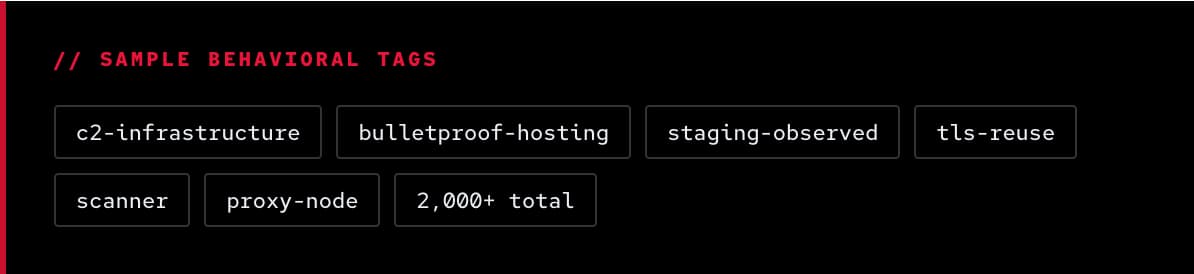
Enriched communications provide accurate, current data that feeds stronger defenses. More than 2,000 analyst-curated behavioral tags mean an indicator arrives already described, not just flagged.
Work you can lift techniques from.
Practitioner research, a live investigation write-up, and case work showing what the enriched return changes in practice.
Research
Navigating the evolving cybersecurity landscape
Where analyst teams say their visibility ends, what slows their triage, and which gaps they would close first given the budget.
Investigation
FIN7 activity on hosting provider infrastructure
A worked investigation tracing FIN7 across hosting provider infrastructure, showing each pivot and the reasoning behind it.
Case Study
Tracing and monitoring adversary infrastructure
How analysts use Pure Signal data to trace, map, and monitor threat actor and victim infrastructure, then defend against it proactively.
The tool provided wonderful enhancements to our threat detection and analysis process. The team is no longer required to use multiple tools to perform threat analysis.
Manager, IT Security and Risk Management
// VERIFIED REVIEW
Scout is an all-in-one tool that efficiently integrates several services, which makes it well suited to the exploration of dangerous threats.
Associate, IT Services
// VERIFIED REVIEW
Send an IP or domain your team is stuck on. An analyst will run it through Scout with you and show you the enriched return, the tags, and the reasoning behind the risk assessment on live telemetry.
Pure Signal™ Command is how analysts access Radar, Recon, and Scout, and the same ground truth underneath all three. A finding in one becomes an investigation in the next without a context switch or a second login.
Questions analysts and buyers ask.
Reference material on external threat intelligence and attack surface management, for anyone who wants the background after the decision is already made.
External threat intelligence is the collection and analysis of information about threats originating outside your network. It covers threat actors, their tactics, techniques, and procedures, and the indicators of compromise observed across the internet. Unlike internal threat intelligence, which looks at activity inside your own systems, external intelligence describes the broader landscape your organization sits in.
Used well, it lets teams anticipate attacks by seeing emerging threats and exploited vulnerabilities early, understand the motives and methods of actors targeting similar organizations, and strengthen defenses on real-world data rather than assumption.
Both aim to improve security posture, but they differ in scope and source. Internal threat intelligence focuses on threats and vulnerabilities inside or connected to your own network and systems, drawing on internal logs, incident reports, employee activity, and system alerts. Its job is identifying internal vulnerabilities, misconfigurations, and insider threats.
External threat intelligence looks outward at infrastructure and behavior you do not own and cannot log. The two are complementary. Neither replaces the other.
Traditional sources aggregate indicators collected from other providers, which means the data arrives second-hand and often late. Pure Signal is derived from network traffic Team Cymru observes directly, through trusted relationships with more than 1,000 network operators, ISPs, and CSIRTs.
The practical difference is provenance. An indicator arrives with the infrastructure story attached because that story was observed, not inferred from someone else's list.
Talent and expertise gaps, by providing enterprise-grade exposure management to organizations without in-house specialists. Real-time detection needs, by supporting mature teams with advanced detection and response requirements. The shift from reactive to proactive defense. And third-party risk arising from expanding vendor ecosystems.
In-depth visibility across external IT assets and the wider digital landscape. Risk-based prioritization through automated scoring and trusted threat data. Enhanced investigations, with contextual intelligence focusing attention on critical risks. Improved workflows through integration with existing security tooling. And support for governance, risk, and compliance requirements.
Asset discovery and mapping, so unmanaged assets do not go unnoticed. Vulnerability management, prioritizing by severity and relevance. Incident response, streamlining identification and accelerating response times. Compliance and risk management, including exposing inherited risk in mergers and acquisitions. And third-party risk monitoring, giving proactive visibility of supply chain exposure.
Yes. Risk reduction can be assessed through decreased vulnerabilities and prevented incidents. Efficiency improvements show up as operational cost savings from streamlined processes. Incident response impact is measurable through reductions in mean time to detect and mean time to resolve.
Tracked over time, those metrics quantify the value delivered by platforms such as Orbit.
Cyber asset attack surface management inventories all cyber assets, internal systems and devices included, by aggregating internal sources. External attack surface management focuses exclusively on internet-facing assets as an attacker would see them.
That outside-in approach surfaces unknown or unmanaged assets, shadow IT, and vulnerabilities that internal tooling misses or that were omitted from inventories through error, oversight, or absent process.
Vulnerable digital assets are used extensively in attacks and appear faster than IT can keep pace with. Rapid digital expansion introduces hidden risk that security teams struggle to track. Proactive risk management requires discovering assets, attributing ownership, and revealing exposure before it is exploited. Frameworks such as NIST provide structure, and standards including GDPR and ISO 27001:2022 make compliance a requirement rather than a preference.
Continuous asset discovery, mapping, and monitoring, with a detailed inventory of domains, IP addresses, and cloud services. Automated scanning and scoring for real-time visibility. Enhanced context through trusted threat intelligence, contextual tags, and analyst-sourced insight. API integrations for data sharing with existing tools. And intuitive dashboards with real-time metrics and reporting.
Orbit operates through continuous asset discovery and mapping to build an inventory of external-facing assets, continuous scanning to identify exploitable weaknesses, threat intelligence integration to contextualize findings, automated risk scoring to prioritize by severity and impact, real-time alerting with remediation recommendations, and integration with SIEM, SOAR, and ticketing systems.
Integration capability with existing SIEM, SOAR, and security tooling. Threat intelligence quality, favoring providers offering trusted, context-enriched data. Coverage and accuracy in risk prioritization and automated workflows. And scalability that aligns with a broader exposure management strategy.
Integration produces unified visibility by combining attack surface data with existing security events. It improves threat detection by uncovering previously undetected activity through enriched data. It improves workflow efficiency by automating ticket creation and tracking. And it supports proactive defense by stopping threats before they escalate.