
November 17, 2026
China-nexus Espionage Against Financial Services: Tracking the Infrastructure Behind the Toolsets
Earlier this year, CrowdStrike published its 2026 Financial Services Threat Landscape report. The report highlighted a notable trend among China-nexus advanced persistent threat (APT) group activities specifically targeting financial services for cyber-espionage and intelligence gathering operations.
This targeting pattern by Chinese APTs is significant because the historical targeting of banks by other hostile nation state adversaries has largely been for financial gain. In 2020, the U.S. Cybersecurity and Infrastructure Security Agency (CISA) released an advisory on a North Korean APT group dubbed BeagleBoyz who targeted bank ATMs and bank SWIFT terminals to steal funds and generate revenue for the regime.
Why Target Financial Services for Cyber-Espionage?
- Economic Intelligence: By gaining persistent access to central banks, national payment gateways, or major commercial banks, Chinese adversaries can monitor real-time economic health, trade volumes, currency fluctuations, and foreign investments. This gives the Chinese government a massive advantage in trade negotiations and macroeconomic planning.
- Personally Identifiable Information (PII): Financial services databases are goldmines for sensitive personally identifiable information (PII), including passport numbers, home addresses, employment history, debt, and income data. This data can be used to build profiles on high-value targets, such as politicians, military leaders, and dissidents, for the purposes of blackmail, recruitment, or tracking.
- Downstream Espionage & Supply Chain Pivot Points: Due to the interconnectedness of most financial systems, an adversary may compromise a large regional bank to monitor transactions and accounts, and gain visibility into government networks, clearinghouses, or multinational corporations doing business in that region.
- China’s Belt and Road Initiative (BRI): The sustained focus on South and Southeast Asia by the Chinese intelligence services is highly strategic. Many countries in these regions are heavily involved in major infrastructure and economic partnerships that support China’s Belt and Road Initiative (BRI). Knowing the exact financial health, debt levels, and internal political anxieties of a developing nation gives an adversary immense negotiation leverage.
Which China-nexus APTs are Targeting Financial Services?
According to CrowdStrike, multiple Chinese APT groups are targeting financial services globally, with a particular focus on the Americas, the Middle East, and Southeast Asia. CrowdStrike’s naming scheme involves tracking Chinese APTs as “Panda” groups. The named adversaries in the report include HOLLOW PANDA, VAULT PANDA, GENESIS PANDA, MURKY PANDA, and VERTIGO PANDA.
HOLLOW PANDA
CrowdStrike noted that HOLLOW PANDA has been observed targeting Check Point VPNs at financial service institutions across South America and Southeast Asia, and deploying the ShadowPad malware.
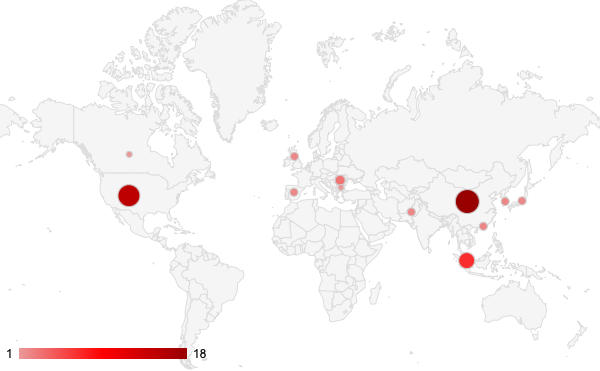
Team Cymru has independently tracked ShadowPad command-and-control (C2) infrastructure throughout 2026, and our data identified 64 ShadowPad C2 servers between January 1 and June 1, 2026. These servers match known ShadowPad C2 patterns. However, Team Cymru has not attributed them to HOLLOW PANDA or to any other specific actor.
GENESIS PANDA
CrowdStrike noted that GENESIS PANDA has been observed targeting a financial institution in Southeast Asia and a fintech firm in North America, and leveraging Vshell and Fscan.
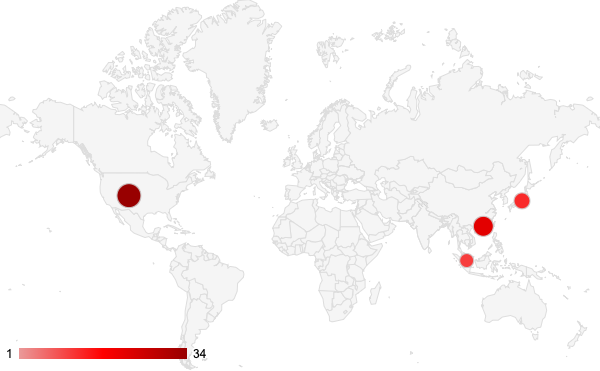
Team Cymru has independently tracked Vshell infrastructure throughout 2026, and our data identified 115 Vshell servers between January 1 and June 1, 2026. These servers match known Vshell patterns. Team Cymru has not attributed them to GENESIS PANDA or to any other specific actor.
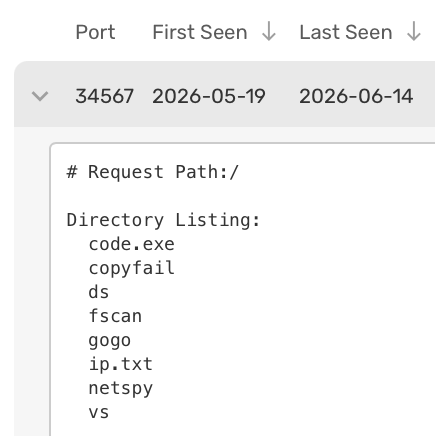
After looking for servers mirroring the infrastructure TTPs of GENESIS PANDA, we identified a notable IP address tagged as Vshell with an Open Directory, as shown below. The Open Directory contained two filename strings “fscan” and “vs,” which after analysis, were Fscan and Vshell binaries.
MURKY PANDA
CrowdStrike noted that MURKY PANDA has been observed operating a unique Operational Relay Box (ORB) network to access Microsoft 365 email accounts globally, and that financial services were among the adversary’s most frequently targeted sectors.
Team Cymru has tracked multiple ORB networks for several years. Our previous blogs have discussed how these networks function, and how Team Cymru can track them via NetFlow intelligence. In February 2026, we also blogged about UNC3886’s long-running ORB campaign against Singapore’s telecommunications sector, in which all four of Singapore’s major telecommunications operators (M1, SIMBA Telecom, Singtel, and StarHub) were targeted. Team Cymru has not attributed the ORB infrastructure we track to MURKY PANDA.
Conclusion
The targeting of financial services by China-nexus APT groups marks a strategic evolution away from the financially motivated bank intrusions historically associated with other types of threat actors.
Across the first half of 2026, Team Cymru identified 64 ShadowPad C2 servers and 115 Vshell servers. CrowdStrike reported these toolsets in use by HOLLOW PANDA and GENESIS PANDA. We also continue to track ORB networks, which CrowdStrike reported MURKY PANDA uses to access Microsoft 365 accounts. Because these toolsets and ORB networks are shared across multiple China-nexus actors, Team Cymru has not attributed any of this infrastructure to any specific Panda group.
The cyber-espionage threat to the global financial sector is both active and broad, spanning multiple adversaries, toolsets, and regions. By combining adversary tradecraft reporting with NetFlow visibility and infrastructure tracking, defenders can move from reactive detection toward proactively identifying perimeter reconnaissance before it escalates into compromise.
Additional Resources
In July 2026, a new project was released called ORBITAL, which stands for Operational Relay Box Intelligence, Tracking, & Analysis Lexicon. ORBITAL was established as a centralized intelligence matrix to track, analyze, and ultimately help defenders disrupt this highly evasive ORB network infrastructure leveraged by advanced China-nexus APT groups.
Search, pivot, and act on internet infrastructure in one AI-assisted environment, built on visibility into 400B+ daily connections.
Search, pivot, and act on internet infrastructure in one AI-assisted environment, built on visibility into 400B+ daily connections.